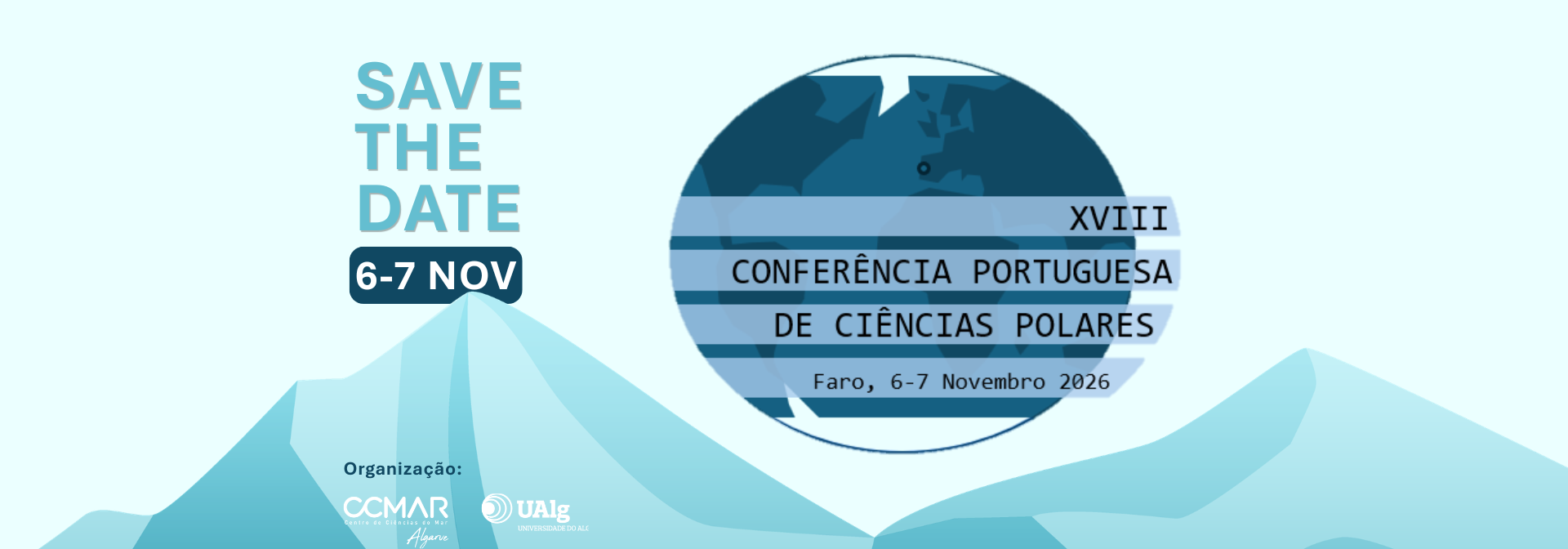
The XVIII Portuguese Conference on Polar Sciences will bring together the national polar research community and its international partners in Faro on 6 and 7 November 2026 to present the latest scientific advances, discuss emerging challenges and promote new collaborations in polar research.
CCMAR is once again hosting the conference, having previously organised it in 2013 and 2022, thereby reinforcing its commitment to research and scientific collaboration in this field.
Calendar
- 1 September: Call for abstracts opens
- 21 September: Registration opens
- 30 September: Deadline for abstract submission (extended)
- 08 October: Deadline for abstract submission
- 16 October: Notification of abstract acceptance
- 20 October: Deadline for early-bird registration
- 16 October: Programme (provisional)
- 2 November: Deadline for registration
- 6 November: Conference
- 7 November: Workshops: APECS Portugal + PEI
If you have any questions about the event, please do not hesitate to contact us: polar2026@ualg.pt
Building Polar Collaboration, Creating Global Impact
Changes occurring in the Arctic and Antarctic have consequences far beyond the polar regions. They affect the global climate system, ocean circulation, sea level, ecosystems, biodiversity and biogeochemical cycles, and increasingly influence environmental, social and economic decision-making worldwide.
Because these processes operate across regions, disciplines and national boundaries, understanding them requires equally broad and coordinated scientific approaches. International collaboration, shared infrastructures, multidisciplinary research and long-term observation are essential to produce more robust, comparable and impactful polar science.
In recent years, several international platforms, networks and coordinated initiatives have been developed or strengthened to support this type of cooperation, facilitate access to polar infrastructures and data, align research priorities and increase the visibility and impact of scientific results. These collaborative frameworks also create stronger links between research and policy, helping to translate scientific evidence into assessments, recommendations and informed decision-making at national and international levels.
From a national point of view:
For the Portuguese polar community, participation in these international structures is particularly relevant. Portugal’s engagement in organisations and frameworks such as SCAR, COMNAP and CCAMLR, among others, strengthens its integration in the international polar research system, supports access to scientific and logistical networks, and increases the visibility and influence of Portuguese research in the development of shared priorities, assessments and policy-relevant knowledge.
This international dimension is also central to the quality and ambition of Portuguese polar science. Collaboration allows national teams to participate in larger and more interdisciplinary research programmes, share expertise and infrastructures, compare observations across regions and timescales, and contribute to scientific questions that cannot be addressed effectively by individual countries or disciplines alone.
The 2026 Conference will therefore provide a forum to present recent results, discuss ongoing and emerging scientific activities, identify new opportunities for collaboration and strengthen links between researchers, institutions and international programmes. It will also provide an opportunity to discuss how scientific excellence, coordinated observation, technological development and interdisciplinary approaches can increase the contribution of polar research to global knowledge and to evidence-based policy.
Building on previous editions, the Conference will continue to support the development of the Portuguese polar community, promote scientific networking, encourage the participation of early-career researchers and reinforce Portugal’s contribution to international polar science.
Polar Collaboration for Global Impact reflects this perspective: global consequences require globally coordinated science, and stronger collaboration can increase both the scientific quality and the societal and policy relevance of polar research.
General Information
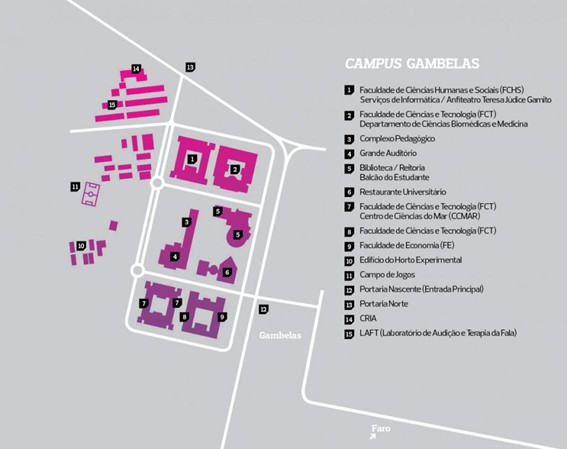
The building is accessible via the main entrance to the Gambelas Campus, approximately 15 minutes by car from the city of Faro. Free parking is available both inside and outside the campus. From the parking areas, follow the signs to Building 8. The auditorium is located on Level -1 of Building 8 (marked as location 9 on the campus map). The building is accessible via the main entrance to the Gambelas Campus, approximately 15 minutes by car from the city of Faro. Free parking is available both inside and outside the campus. From the parking areas, follow the signs to Building 8.
Map of the Gambelas Campus
Faculty of Economics – 9; University Canteen – 6
Poster sessions and exhibitions will take place in the hall area and adjacent spaces.
Lunches will be served at the Gambelas University Canteen (location 6 on the campus map), approximately a 5-minute walk from the conference venue.
How to get there
To find out the best way to get there, please consult the guide containing transport details and all the information you need, which is available to download here.
Please do not hesitate to contact us: polar2026@ualg.pt
_
Invited Speakers:
DIEGO FILUN | Coordinator Antarctica InSync (online)
- The Antarctica InSync is an international initiative under the UN Ocean Decade that promotes coordinated, interdisciplinary research. This global scientific project will synchronise research in Antarctica and the Southern Ocean. The implementation and analysis phase will take place from 2027 to 2030, with joint field campaigns on land, at sea and in the air. The preparatory phase started in 2024. Antarctica InSync brings together the research themes of ice, ocean, climate and life.
MARIA GRIGORATOU | European Polar Board (online)
- Maria is the Executive Secretary of the European Polar Board and Head of the European Polar Coordination Office (EPCO). A biological oceanographer with a PhD in Marine Ecology and Ecosystem Modelling from the University of Bristol, her work combines ecosystem science, modelling, international coordination and science diplomacy, with extensive experience in leading research and fostering collaboration across scientific, policy and stakeholder communities.
- The European Polar Board (EPB) strengthens coordination and collaboration in Arctic and Antarctic research across Europe. Bringing together organisations from 22 countries, it connects research institutes, funders, academies, ministries, and polar operators to support joint priorities and more effective use of research infrastructure. The EPB also promotes multilateral cooperation and acts as a key link between the European and global polar research communities.
The European Polar Coordination Office (EPCO) functions as a central contact point for European polar research community, policymakers and decision-makers, including the European Commission.
PHILIPPE ARCHAMBAULT | Université Laval, Canada, and ArcticNet
Dr. Philippe Archambault is a Professor of Biology at Université Laval, Canada, and holds the Canada Research Chair in Biodiversity and Ecosystem Functioning in a Changing Ocean. He is the Scientific Director of ArcticNet and Director of the International Research Laboratory Takuvik (CNRS–Sorbonne Université–Université Laval). His research focuses on marine biodiversity, ecosystem functioning, and the impacts of climate change, bridging fundamental science with environmental policy and management. His work has contributed to the establishment of marine protected areas in Canada and informed international environmental decision-making, including at the United Nations.
He is also the Scientific Director of ArcticNet, a Canadian non-profit organization dedicated to advancing Arctic research and supporting adaptation strategies and policies addressing climate and socioeconomic change. Primarily funded by the Government of Canada, ArcticNet promotes multidisciplinary research, capacity building, and the integration of scientific and Indigenous knowledge. It fosters national and international collaboration by connecting researchers, institutions, and Northern and Indigenous communities, creating opportunities for joint research projects, knowledge exchange, and collaborative initiatives.
Abstracts
Abstract submission is now closed
Topics
Abstracts should indicate a main topic and a secondary topic.
- A. Biodiversity, Ecology and Ecosystem Function
- B. Physiology, Adaptation and Biological Responses to Change
- C. Polar Oceans, Biogeochemistry and Aquatic Systems
- D. Atmosphere, Climate and Cryosphere
- E. Geology, Geophysics and Polar Earth History
- F. Polar Observation, Remote Sensing, Planetary Sciences and Extreme Environments
- G. Human Dimensions, Governance and Sustainability
- H. Technology, Infrastructure, Collaboration and Science Policy
Oral Presentations
Oral presentations should be presented in English and have a duration of 15 minutes (regular communications - 10' presentation + 5' questions). Oral presentations will be performed in person.
Posters
Posters should be presented in English with the A0 dimension (1189 mm x 841 mm; height x width).
Best Communication Award
Prizes will be awarded to the best oral presentation and to the best poster presented by students or young researchers. The request for inclusion in the list of communications to be evaluated must be indicated on the abstract submission form. Only communications in which the presenter is the author under evaluation will be considered.
Abstracts
Abstracts should be in English, with a maximum of 2000 characters (including spaces) or 300 words in text (excluding title, authors and affiliations). All abstract elements must fit in a single page with the indicated formatting and font size. Maximum of 3 abstracts per scientist (2 for oral presentations and/or 3 for posters).
Abstract submission is now closed.
Early Bird until 20 october
| Registration type | Early Bird Fee | Regular Fee |
| Undergraduate students | 15€ | 20€ |
| Early-career researchers* and postgraduate students** | 35€ | 45€ |
| Scientists, university lecturers and other interested parties | 50€ | 60€ |
*Scientists who have completed their PhD within the last 5 years, subject to proof (by uploading a PhD certificate issued within the last 5 years)
** You will need to prove your status as a postgraduate student by completing and uploading a declaration.
There are two ways to register and make payment; please choose the one that suits you best:
Registration with automatic digital payment via MBWAY, MB Reference or VISA.
Register here for digital payments
Registration with manual payment via bank transfer; the details will be sent by email once the form has been submitted, and proof of payment must be provided.
NOTE: For any queries regarding payment, please contact us at expediente@ualg.pt, quoting the subject line “CPCP 2026”.

Related events