The “3MT-UAlg” competition once again challenged PhD students at the University of the Algarve to distil years of scientific research into clear, accessible and impactful presentations lasting just three minutes. Inspired by the model created by the University of Queensland in Australia, the initiative aims to foster scientific communication skills, promote interdisciplinarity and bring science closer to the public. The competition is divided into two stages: an initial selection via video and slides, followed by an oral presentation before a jury and an audience. More than just a competition, the 3MT has become an opportunity for researchers to learn how to communicate their work beyond the academic context.
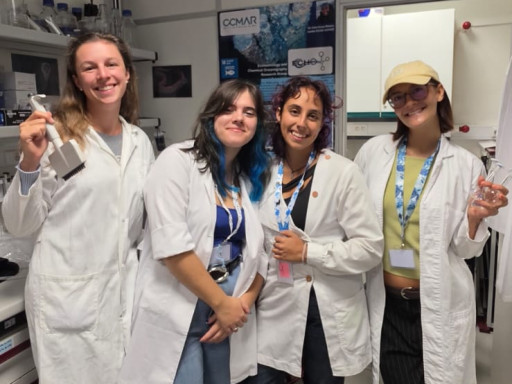
This year, CCMAR was represented by four PhD students who did a fine job of showcasing the centre’s research.
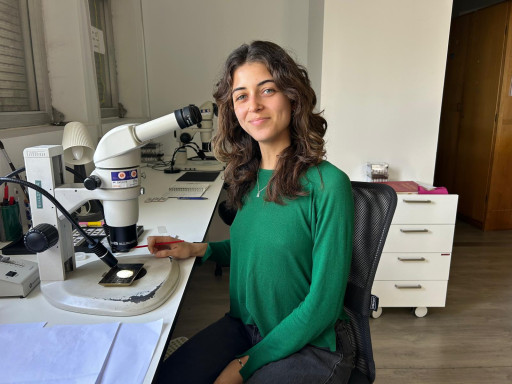
Among the participants was Daniela Castro, whose research aims to make aquaculture more efficient by using modified microalgae in fish feed. The study explores how nutritional changes can reduce skeletal deformities and increase the survival of fish in aquaculture. The results show that fish fed with microalgae grown in media enriched with iron and nitrogen exhibited better growth and fewer deformities. For Daniela, the biggest challenge was precisely adapting a technical discourse into accessible language:
I think the most challenging part was adapting a thesis and a typically more technical presentation for a general audience. So I wrote a speech that I refined over time, using my family as ‘guinea pigs’ to see if the story came across clearly.
The student also highlights the importance of the experience in developing communication skills:
“I learnt how to communicate science in a simple and accessible way. What’s more, listening to the other participants’ presentations gave me new perspectives and was a great opportunity for learning and inspiration.”
Rui Peres dos Santos also presented research focusing on the impact of climate change on the migratory routes of baleen whales in the North Atlantic, with a particular focus on the Azores region. Rui sought to understand how global warming might alter the “migratory highways” of these species and jeopardise the presence of blue whales in the Azores by the end of the century. Among the 866 individuals already identified in the region, 144 are blue whales — the highest number recorded in a single region of the North Atlantic. The models developed indicate a significant reduction in habitat suitability under scenarios of increased climate stress, with particularly significant impacts for the blue whale.
For the PhD student, the main challenge of the competition was learning to synthesise complex research:
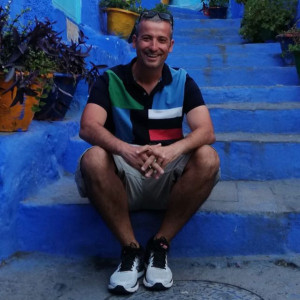
My preparation involved practising a presentation style that was the opposite of what comes naturally to me, as I usually tend to explore a topic in great depth. In this case, I first had to craft a more concise speech that could summarise my knowledge in a few words, and then weave it into a presentation that flowed naturally and scientifically.
Rui also highlights the impact of the experience on the way he communicates science:
“It was a valuable experience in learning to get straight to the heart of the matter, avoiding digressions and making the presentation accessible to an audience with diverse backgrounds. It went a long way towards developing my ability to summarise and communicate scientific ideas.”
Camila Vieira da Costa, meanwhile, presented a new perspective on micro- and nanoplastics, focusing not only on their physical fragmentation but also on the chemical transformations that occur during environmental degradation. Her work demonstrates that, when exposed to ultraviolet radiation and heat, plastics can give rise to new compounds with their own chemical signatures, specific to each material. This approach paves the way for new forms of environmental monitoring, allowing us to go beyond simply counting particles and investigate the products resulting from their degradation.
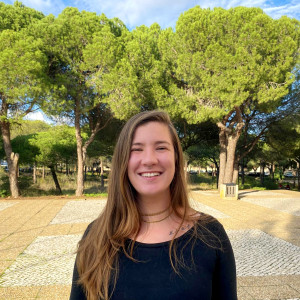
It is certainly challenging to simplify complex scientific topics and make them accessible to the general public, but communicating science is just as important as producing it. The first stage of the competition requires the submission of a video of up to three minutes’ duration, unedited and with direct eye contact with the camera, which in itself was a major challenge, but which, in a way, also served as preparation for the second stage.
In the face-to-face presentation, in addition to the public presentation itself, we had to deal with nerves, hold the audience’s attention and, at the same time, maintain scientific rigour when communicating our project.
The study also raises new questions about toxicity and ecological impact: what are these compounds, where do they accumulate, and how do they interact with ecosystems? Camila points out that this experience was very enriching and that it forces one to step outside one’s comfort zone. It also provides an opportunity to develop scientific communication and networking skills:
We also had the opportunity to interact with researchers from other fields, build our self-confidence and participate in an environment of exchange and learning, as well as, of course, competing for the prize.
The science produced behind the scenes in laboratories becomes even more rewarding when we manage to convey our knowledge by sparking curiosity, creating connections and bringing science closer to people.
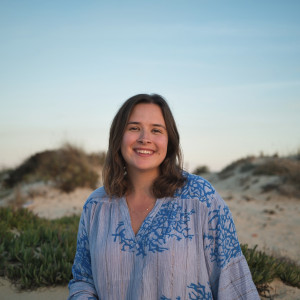
In the same competition, Sari Ponnet was awarded second prize, worth €2,000, for a project dedicated to the restoration of seagrass beds through the integration of spatial mapping, nursery cultivation and community involvement. Seagrass beds are ecosystems that are often underestimated, despite their essential role in coastal protection, biodiversity, fisheries and carbon sequestration.
For Sari, the preparation was an intense and ongoing process of refining the scientific narrative:
“I started by writing my text and then continuously changing and refining it while saying it out loud while looking at the beach, to the waves, the boats, and the dunes while trying to make the story flow naturally. Once I felt happy with the text, I started studying it by heart everywhere: in the shower, in bed, while walking… I quickly realised that knowing the text alone was very different from saying it in front of people."
The researcher also emphasises the importance of engaging with different audiences during the preparation and confides that she deliberately simulated high-pressure situations:
So I started practicing with my friends, family, my boyfriend, friend of friends, and even during dinners with non-marine biologists. Their reactions and feedback really helped me refine certain lines and make the story clearer for a broader audience. The day before the competition, I also presented it to professors and people I look up to, mainly to increase my stress levels and mimic the pressure of the actual event. I also filmed myself to look at my hand movements and see what I could improve in this regard.
The “3MT-UAlg” thus continues to establish itself as a platform that challenges young researchers to translate complex science into clear, accessible and impactful messages, reinforcing the importance of scientific communication in bridging the gap between research and society.