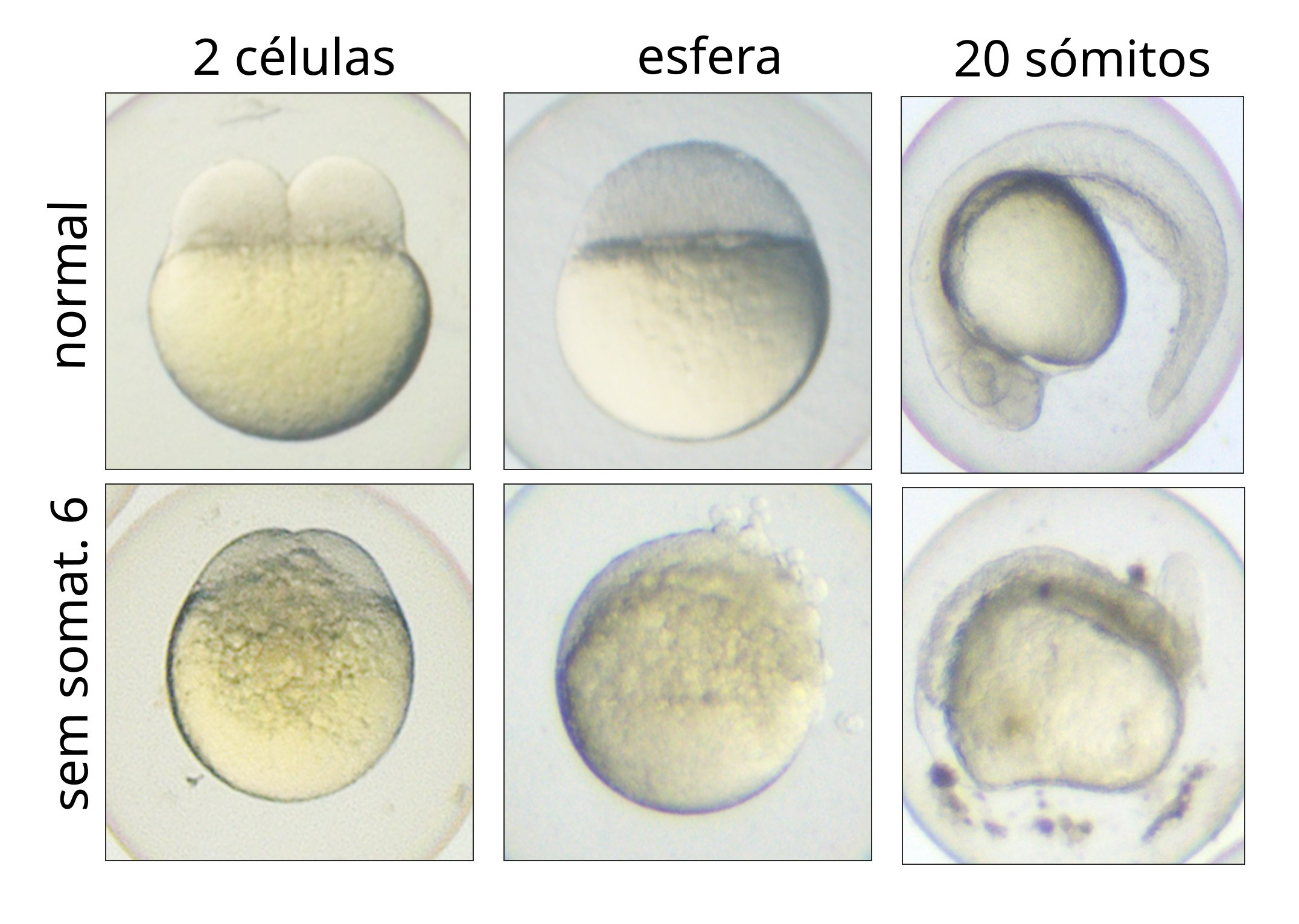
An RNA molecule present in the egg prior to fertilisation has been found to be crucial for the early stages of embryonic development in zebrafish. Its absence disrupts cell division and the activation of the embryo’s genome, preventing its normal development. The discovery, published in the journal Science Advances, reveals a molecular mechanism that is essential for the beginning of life.
In oviparous animals, mothers store nutrients, ribonucleic acids (RNAs) and other factors in the egg. Many of these maternal RNAs are translated into proteins by the embryo at an early stage, whilst its genome is not yet active. In zebrafish, this activation of the genome occurs between 3 and 6 hours after fertilisation. Until then, these maternal RNAs are essential for embryonic development. The absence or malformation of any of these maternal RNAs can cause specific defects that may render the embryo partially or completely non-viable.
A team of researchers from the Centre for Marine Sciences (CCMAR), the University of the Algarve and Shanghai Ocean University has identified one such maternal RNA, encoded by the somatostatin 6 (sst6) gene. The removal of this molecule disrupts virtually all the early stages of embryonic development, resulting in the death of the embryo.
The ‘master’ molecule of embryonic development
It is a ‘master’ RNA due to its early role, immediately after fertilisation, and without it, virtually all developmental processes are compromised.
In investigating the mechanism involved, the researchers discovered that the protein associated with this molecule regulates the release of calcium within cells. Calcium is essential for various cellular processes, including the functioning of the cytoskeleton, which is necessary for cell movement and division.
In practice, they found that certain proteins for which calcium is essential failed to polymerise and that cell divisions were incomplete, resulting in embryos with abnormalities that died after a short time. They also found that calcium waves were necessary at later stages, such as the phosphorylation of certain proteins—known as transcription factors—which are essential for the activation of the embryo’s genome.
This research has therefore revealed the existence of a molecule that plays a vital role at various stages of embryonic development.

"This is a molecule that is essential for embryonic development in zebrafish and, most likely, in all animals that produce eggs with a yolk."
According to Adelino Canário, the research coordinator, the molecule is essential for zebrafish development and may play a similar role in other animals that produce yolk-containing eggs. He himself states that “this is a molecule that is essential for embryonic development in zebrafish and, probably, in all animals that produce yolk-containing eggs”. Many of us have heard of somatostatin, a neurohormone with multiple functions, including the regulation of growth, the discovery of which earned Roger Guillemin and Andrew Schally the 1977 Nobel Prize in Physiology or Medicine. Somatostatin 6 is a very closely related molecule, which has acquired a very different function”.
The study highlights the importance of maternal RNAs in regulating embryonic development and contributes to a deeper understanding of the cellular and molecular mechanisms that enable the development of organisms.
Press release (only available in portuguese)
Scientific paper
Title: Somatostatin 6, a master maternal mRNA driving early development
Authors: Jie Chen, Jing Gao, Ting Nie, Lu Liu, Huiming Yuan, Rute S. T. Martins e Adelino V. M. Canário