Imagine searching for clues about changes in the ocean within tiny shells preserved for millions of years in deep-sea sediments. This is the potential of planktonic foraminifera: microscopic organisms that live in the water column and whose fossilised shells enable us to reconstruct aspects of the marine environment of the past. One such species, Neogloboquadrina atlantica, inhabited the North Atlantic from the Upper Miocene (~11.76 million years ago) onwards. Although now extinct, it continues to play a key role in scientific research, helping to date marine sediments and interpret the oceanic conditions of bygone eras.
The same species, two distinct forms, different endings
How can we reconstruct the history of this species? The researchers analysed fossils from various regions of the North Atlantic, combining abundance counts with geochemical analyses. The ratios of oxygen and carbon isotopes in the shells act as a thermometer and a chemical record of the environment. These data revealed that the dextral form (right-spiral) predominantly inhabited subsurface waters, in the thermocline zone, with ecological preferences similar to those of some modern species. One of the study’s major findings is that the two morphotypes (see Figure 1) — distinguished by the direction of the shell’s coil — followed entirely different extinction trajectories. The sinistral form (left-coiling) ceased to be recorded globally around 2.4 million years ago. The dextral form, on the other hand, underwent a markedly diachronous (time-staggered) extinction: it disappeared first from the colder subpolar regions (between 1.8 and 1.9 million years ago), but persisted in the warmer waters of the northern subtropical gyre and off Portugal until around 1.3 million years ago. This difference proves that the extinction of the species did not occur at a single moment across the entire ocean, but followed geographical patterns dictated by latitude. The authors link these patterns to the progressive cooling of the Northern Hemisphere and to increased glacial–interglacial climatic instability, which reorganised ocean circulation and drastically reduced suitable habitats.
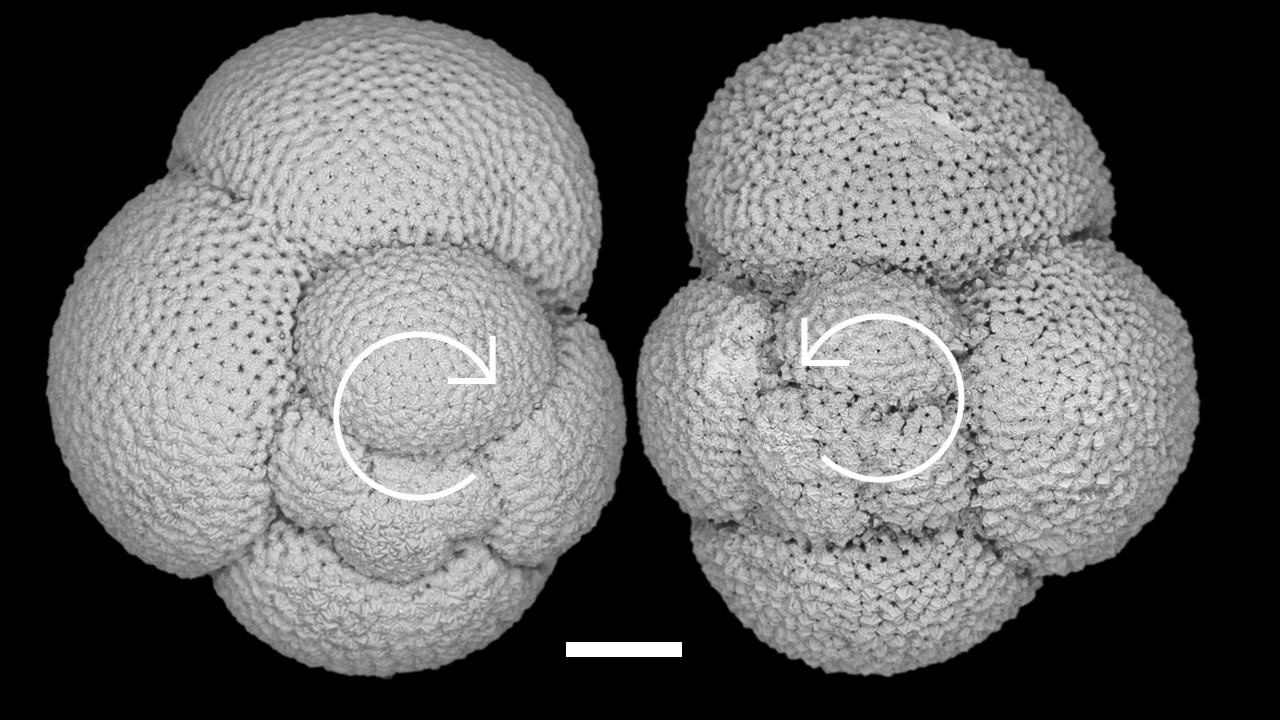
Fig. 1 - Dorsal views of Neogloboquadrina atlantica showing the two coiling morphotypes. Left: dextral (right-coiling) specimen from IODP Site U1313 (U1313C-7-3, 148–150 cm; 1.307 million years ago). Right: sinistral (left-coiling) specimen from ODP Site 981 (981-17-3, 40–42 cm; 2.482 million years ago). White arrows indicate the clockwise (dextral) and counterclockwise (sinistral) coiling directions, respectively. Scale bar: 100 µm.
What do these little shells tell us?
These microfossils are much more than mere traces of the past: their distribution across time and space is a powerful tool for establishing geological chronologies. The study shows that ignoring differences between forms of the same species or between geographical regions can lead to misinterpretations: the last occurrence of a fossil varies depending on the location. By piecing together these histories, science gains a much more accurate picture of how marine habitats respond to global climate change.
Published article: Duque‐Castaño, M., Raymo, M., Billups,K., Andersen, N., Kuhnert, H., & Voelker,A. H. L. (2026). The rise and fall of Neogloboquadrina atlantica: Distribution and extinction in the North Atlantic. Paleoceanography and Paleoclimatology,41, e2026PA005550.
https://agupubs.onlinelibrary.wiley.com/doi/10.1029/2026PA005550