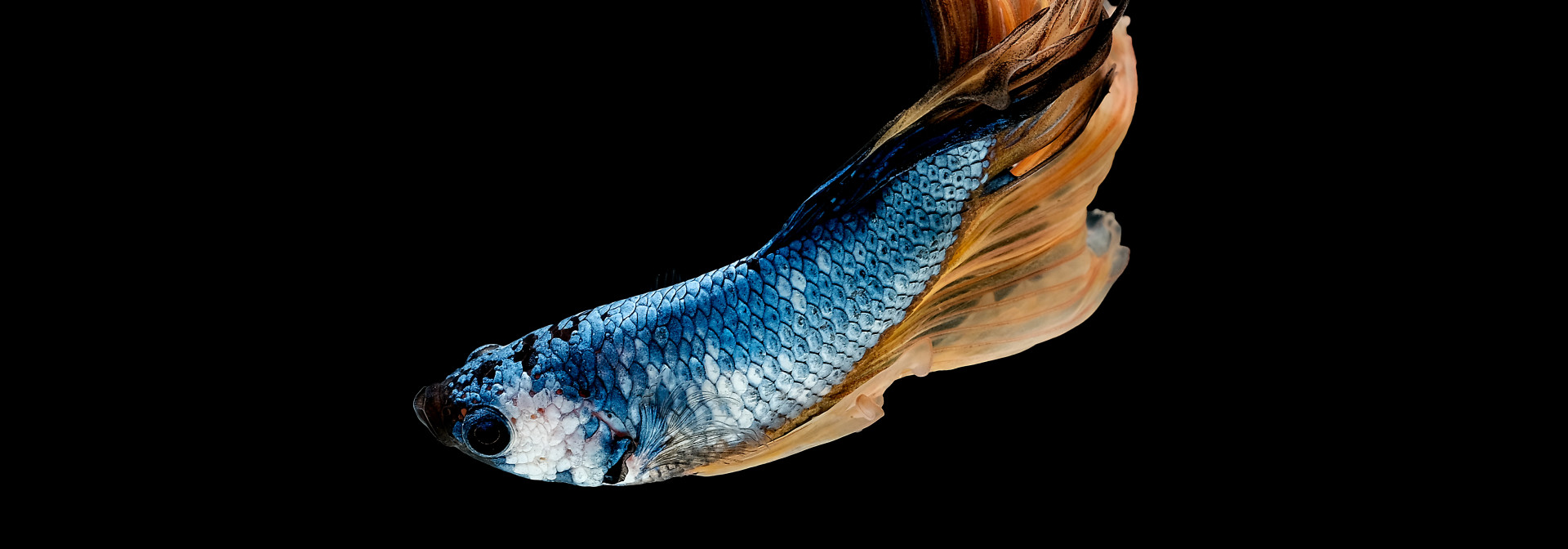
The Siamese fighting fish (Betta splendens) is one of the most widely used species in animal behaviour research, serving as a model for studying aggression, territoriality and social interactions in vertebrates. Its strong responsiveness to social stimuli, combined with clear patterns of dominance, has made it a valuable experimental system in fields such as neuroscience, behavioural genetics and physiology.
Despite its widespread scientific use, questions remain regarding the mechanisms that regulate social behaviour in this species, particularly with regard to aggression between individuals and the possible role of different sensory cues in these interactions.
It was within this context that Melina Silva undertook her PhD in Biological Sciences at the University of the Algarve, in collaboration with CCMAR – the Algarve Centre for Marine Sciences and the University of Saint Joseph.
The work focused on investigating the possible existence and relevance of chemical signals associated with aggressive interactions in Betta splendens, exploring the hypothesis that compounds released during confrontations between males could influence the behaviour of other individuals.
Throughout the PhD, this hypothesis was tested using an integrated approach to animal behaviour, combining behavioural tests, electrophysiology (EOG), histology, immunohistochemistry and analysis of brain regions associated with sensory processing.
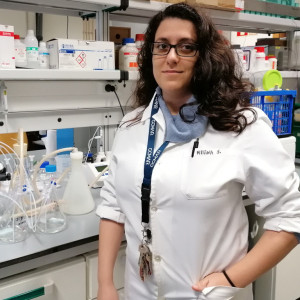
This project struck me as a natural choice, an opportunity to step outside my comfort zone and work directly with animals, gaining a deeper understanding of their behaviour than I had previously. I was also drawn to the possibility that the chemical compounds involved in communication might have potential real-world applications, which made the subject even more fascinating.
Rather than merely confirming pre-established hypotheses, this study sought to directly test the possible role of chemical communication in modulating aggression between male Siamese fighting fish.
Re-evaluating the role of chemical signals
One of the main findings of this PhD research was the lack of evidence to support a dominant role for compounds released during aggressive interactions in modulating behaviour in this species. This finding helps to clarify a long-standing scientific question, which has been explored over several decades with as yet inconclusive results, reinforcing the need to reassess the relevance of chemical communication in aggression in Betta splendens.
At the same time, the study revealed high individual variability in the expression of aggressive behaviours and in the response to social stimuli, suggesting that this behaviour is highly plastic and individual-dependent.
Impact on the biology of the species
Although some initial hypotheses have not been confirmed, the results represent a significant contribution to the fundamental biology of Siamese fighting fish. In basic science, unexpected results play an essential role in consolidating or revising theoretical models, enabling us to refine existing knowledge and avoid overly simplistic interpretations.
In this case, the study helps to clarify a long-standing scientific debate regarding the role of chemical communication in the species, contributing to a more integrated and realistic view of the sensory mechanisms involved in aggression. This knowledge also has indirect relevance for applied fields, particularly in animal welfare within aquaculture and the keeping of ornamental species, as well as in the use of this species as a model organism in biomedical and behavioural research.
Networked science
The completion of this PhD was made possible by a collaborative network of institutions and researchers. At CCMAR, the work was supervised by Adelino Canário and Peter Hubbard. The part of the research carried out at the University of Saint Joseph was supervised by David Gonçalves. The research also benefited from the collaboration of Nathalie Marquet, Zélia Velez, Andreia Ramos and Sara Cardoso, whose technical and scientific contributions were essential throughout the project. This collaborative framework, combined with access to complementary infrastructure across institutions, was crucial to the development of a truly multidisciplinary approach.
New horizons
Having completed her PhD, Melina Silva intends to continue her career in scientific research, maintaining her focus on behavioural biology and animal communication, with a particular interest in exploring these topics further in a postdoctoral context.
“My aim is to continue my research, exploring new scientific questions and contributing to the academic community. The collaborative environment and the facilities available were essential to the development of this work and will be equally important in the next stages of my career.”
Here is a reference article on this study:
da Silva MC, Canário AVM, Hubbard PC, Cardoso SD, Gonçalves DMF. High variability in aggression and habituation to the mirror assay in ornamental Siamese fighting fish Betta splendens. Acta ethologica. https://doi.org/10.1007/s10211-025-00469-9