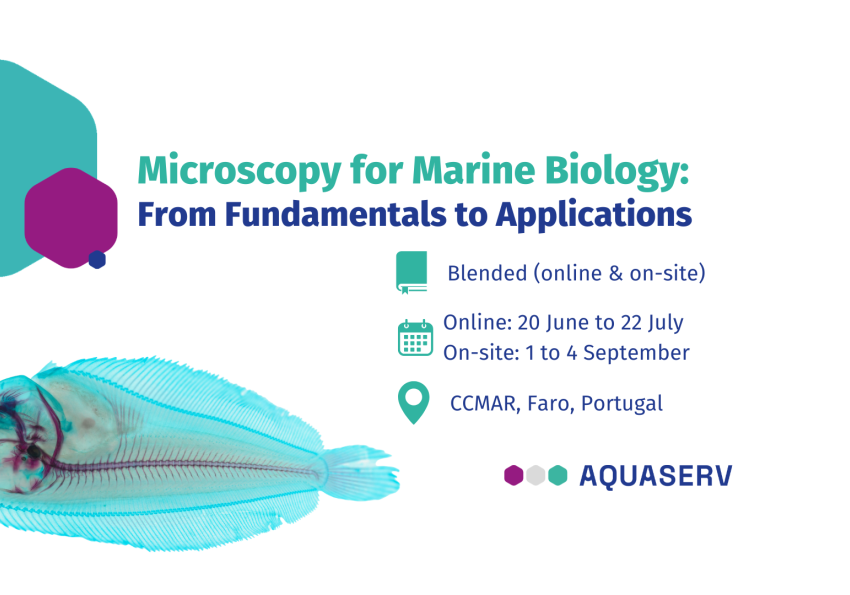
Microscopy is among the most widely used techniques to quantify and illustrate processes in biology. However, given the diversity of available methods and the rapid pace of technological development, it can be challenging for researchers to gain both a clear overview of microscopy methods, and the practical knowledge of their applications.
This course introduces the fascinating world of optical microscopy applied to marine sciences and aquaculture. Drawing on the expertise of microscopy specialists across the AQUASERV consortium, the course is cross-disciplinary while keeping marine organism imaging as the common thread. Training covers the underlying principles of optical microscopy and shows how to make the best use of imaging technologies available at research infrastructures — from brightfield to advanced approaches such as fluorescence, confocal, and lightsheet microscopy. Through examples from aquaculture and marine biology, participants will follow the complete workflow: learning the fundamentals of microscopy, selecting the right technique for their research question, preparing and imaging marine samples, addressing the unique challenges of marine specimens, and applying modern tools for image analysis and data management.
We aim to develop a course that becomes a reference in the field of marine biology and aquaculture. To ensure continuity and adaptability, we plan on repeating this course regularly, rotating between marine stations and tailoring the practical component to the imaging technologies available on site.
Course Contents
Part 1 (Online: 22 June - 22 July 2026)
- Light Principles
- Fundamentals of Optical Microscopy: know your microscope
- Brightfield imaging and Contrast enhancing techniques - exploring aquatic and marine microorganisms
- Introduction to Fluorescence Microscopy
- Optical sectioning and advanced imaging
- Specialised tools for marine monitoring
- Sample preparation techniques and challenges
- Introduction to image analysis for aquaculture and marine biology
- Conclusion remarks: overview of optical microscopy techniques for marine sciences
Part 2 (Onsite: 1 - 4 September 2026, venue CCMAR, Faro, Portugal)
in person - practicals, demos, consolidating theoretical concepts with a practical approach
Course Instructors:
- Carina Mónico, CCMAR, Portugal
- Lucía Sánchez Ruiloba, Instituto de Investigaciones Marinas CSIC, Vigo, Spain
- Sébastien Schaub, LBDV, Institut de la Mer de Villefranche, France
- Xabier Lecube (Plentzia Marine Station, PiE-UPV/EHU, University of the Basque Country, Spain
- Margaux Failla, LBDV, Institut de la Mer de Villefranche, France
- Samah Rekima (IPMC, CNRS, France)
- Kleoniki Keklikoglou (Institute of Marine Biology, Biotechnology and Aquaculture, HCMR, Greece)
- Sophie Le Panse, Station Biologique de Roscoff, France
- Marie Walde, SBR RCC, Sorbonne University, France
- Tania Tato Vidal (Toralla Marine Science Station, ECIMAT, Vigo, Spain)
- Caio Ribeiro, CCMAR, Portugal
- Joana Leal, CCMAR, Portugal
- Teresa Correia, CCMAR, Portugal
- Sandra Rebocho, CCMAR, Portugal
- Paulo Gavaia, CCMAR, Portugal
- Vincent Laizé, CCMAR, Portugal
- Lelde Hermane, CCMAR, Portugal
- others to be announced
Course Coordination:
Carina Monico, Imaging Platform, CCMAR
Sébastien Schaub, LBDV, Institut de la Mer de Villefranche
Claudia Delgado, Marine Training Unit, EMBRC/EMBRC-BE-UGent
This course has been funded with support from the European Commission. The AQUASERV project has received funding from the European Union’s HORIZON Research and Innovation Actions under grant agreement N° 101131121.
Target Audience
Early Career Researchers: MSc students, PhD candidates, and postdoctoral researchers in marine biology, aquaculture, fisheries, and related life sciences.
Research Infrastructure staff: technicians and facility managers seeking to upskill in microscopy and image analysis.
Industry professionals and entrepreneurs: users from aquaculture, blue biotechnology, and environmental monitoring who want to integrate imaging into their workflows.
Senior researchers and group leaders: those who use microscopy but lack formal training in its principles, and who wish to better supervise students, critically assess image data, and refine or expand their experimental workflows.
Transnational Access (TNA) users of the AQUASERV project: researchers preparing or participating in a TNAcall who want to learn microscopy fundamentals to apply these methods in their planned experiments.
Prerequisites
- No previous microscopy training is required.
- Participants should demonstrate a strong interest and motivation in microscopy, whether as current users or as researchers already doing bioimaging, or planning to include microscopy in their future projects.
- Successful completion of the online Part I modules (theory and quizzes) is mandatory for participation in the in-person workshop.
Application procedure
Please fill in the Registration form no later than 15 June 2026.
A limited number of seats for the onsite phase is available (20 participants maximum). Selection will be based on motivation and successful completion of the online phase.
Grant opportunities
Pending on external funding the tuition fee for the onsite phase may be reduced.
Learning outcomes
By the end of the course the learner will be able to:
- Explain the fundamental principles of light and optical microscopy.
- Describe the main microscopy techniques, including brightfield and fluorescence microscopy.
- Compare and evaluate the strengths and limitations of key imaging approaches (brightfield, fluorescence,confocal, lightsheet) for different marine samples.
- Prepare and mount a range of marine specimens for microscopy.
- Apply simple tricks and good practices to improve image quality.
- Design a microscopy experiment tailored to a research question in aquaculture or marine biology.
- Operate simple imaging systems and implement key practices for acquiring reproducible image data,independently of the specific microscope available.
- Retrieve and interpret meaningful quantitative data from microscopy images.
- Identify and apply modern open-source tools to address image analysis
Cognitive competences:
- Understanding limitations and artefacts in optical microscopy.
- Selecting appropriate workflows for different research applications.
- Integrating microscopy into experimental design in aquaculture and marine biology.
Technical skills:
- Operate brightfield, contrast-enhancing, and fluorescence microscopy systems.
- Apply sample preparation techniques suitable for marine specimens.
- Acquire and evaluate microscopy images, recognising the features of high-quality data regardless of themicroscope used.
- Use open-source software tools for basic image processing and analysis.
This advanced training course provides an integrated and multidisciplinary framework for environmental monitoring in sustainable aquaculture systems. It combines state-of-the-art chemical analytical techniques (LC-MS/MS, MP-AES, biotoxin analysis), standardized ecotoxicological bioassays, molecular biomarkers, and environmental risk assessment methodologies.
The course bridges theoretical knowledge and practical laboratory implementation. Participants will gain direct experience with cutting-edge Research Infrastructure (RI) facilities and develop competencies to design, implement and interpret integrated monitoring programs tailored to aquaculture environments.
Learning outcomes
By the end of the course the learner will be able to:
- Explain the fundamental principles of light and optical microscopy.
- Describe the main microscopy techniques, including brightfield and fluorescence microscopy.
- Compare and evaluate the strengths and limitations of key imaging approaches (brightfield, fluorescence,confocal, lightsheet) for different marine samples.
- Prepare and mount a range of marine specimens for microscopy.
- Apply simple tricks and good practices to improve image quality.
- Design a microscopy experiment tailored to a research question in aquaculture or marine biology.
- Operate simple imaging systems and implement key practices for acquiring reproducible image data,independently of the specific microscope available.
- Retrieve and interpret meaningful quantitative data from microscopy images.
- Identify and apply modern open-source tools to address image analysis
Cognitive competences:
- Understanding limitations and artefacts in optical microscopy.
- Selecting appropriate workflows for different research applications.
- Integrating microscopy into experimental design in aquaculture and marine biology.
Technical skills:
- Operate brightfield, contrast-enhancing, and fluorescence microscopy systems.
- Apply sample preparation techniques suitable for marine specimens.
- Acquire and evaluate microscopy images, recognising the features of high-quality data regardless of themicroscope used.
- Use open-source software tools for basic image processing and analysis.
Course Contents
Part 1 (Online: 7 - 25 September 2026)
- M1: Priority Contaminants: metals, PAHs and pharmaceuticals
- M2: HABs, Phytoplankton and Marine Biotoxins
- M3: Emerging Contaminants and Nanoecotoxicology
- M4: Bioassays, Biomarkers and Analytical Platforms
- M5: Data Integration, Risk assessement and Regulation
Part 2 (Onsite: 6 - 9 October 2026, venue CCMAR, Faro, Portugal)
- M6: Field Sampling and Chemical Analysis (Ria Formosa field trip, sample preparation, MP-AES metals analysis
- M7: Plankton, HABs and Biotoxins (FLOWCAM imaging, microscopy, biotoxin LB-MS/MS)
- M8: Bioassays and Biomarkers (acute and sublethal tests, nano exposures, biomarker assays)
- M9: Integration and Final Project (data analysis, project presentation)
- Dr. Caio Cesar Ribeiro (CCMAR – University of Algarve)
- Dr. Roberto Martins (CESAM – University of Aveiro)
- Dr. Patricia Pinto (CCMAR)
- Dr. Vera Ribeiro (UAlg)
- Dr. Domenica Lima (UERJ/PETROBRAS, Brazil)
- Dr. Sandra Lage (CCMAR)
- Dr. Marco Fontela (CSIC Vigo, Spain)
- Dr. André Belém (UFF, Brazil)
- Dr. Caio Cesar Ribeiro (CCMAR – University of Algarve)
- Claudia Delgado & Yens Vandenboer, Marine Training Unit, EMBRC/EMBRC-BE-UGent
Application
Please fill in the Registration form no later than 2 August 2026 (23:59 CEST).
A limited number of seats for the onsite phase is available. Selection will be based on motivation and successful completion of the online phase.
This course is organized and sponsored by the AQUASERV Project. There is no tuition fee to attend the onsite phase. The organizers will offer coffee breaks/refreshments and (light) lunch during the onsite event.
All other costs must be borne by the participant and/or its parent institution (travel, accomodation, etc).
Target Audience
- PhD students and postdoctoral researchers
- Aquaculture industry professionals
- Research Infrastructure technical staff
- Transnational Access (TNA) users of the AQUASERV project: researchers preparing or participating in a TNA call who want to learn ecotoxicology fundamentals to apply these methods in their planned experiments.
Prerequisites
- Background in marine science, environmental science, biology, chemistry, or related fields
- Basic understanding of environmental monitoring principles
- Preference for researchers working on or planning to work in:
- Marine pollution
- Chemical oceanography
- Aquaculture successful completion of the online Part I modules (theory and quizzes) is mandatory for participation in the onsite phase.
This course has been funded with support from the European Commission. The AQUASERV project has received funding from the European Union’s HORIZON Research and Innovation Actions under grant agreement N° 101131121.
Related events