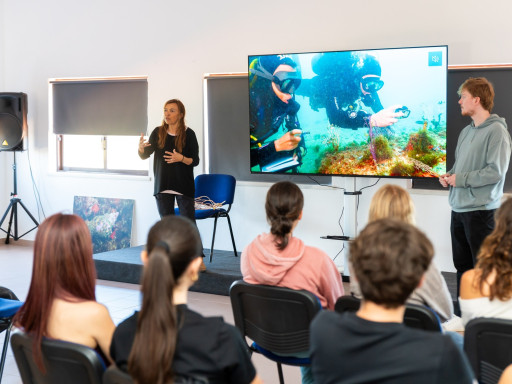
After three years of collaboration across Europe, the Erasmus+ project TeachBlue has officially concluded, leaving behind a set of open-access educational resources designed to help early childhood educators introduce ocean literacy to children aged 4 to 8.
With the active contribution of CCMAR, TeachBlue has transformed marine science knowledge into practical, playful, and age-appropriate learning experiences, helping teachers bring the ocean into classrooms through storytelling, exploration, play, and immersive digital experiences.
Developed by partners from Poland, Greece, Cyprus, and Portugal, and co-funded by the Erasmus+ Programme, TeachBlue responds to a growing international recognition that ocean literacy should begin early when curiosity, empathy, and environmental awareness are first formed
From marine science to classroom discovery
At the heart of TeachBlue is a simple but ambitious goal: to help children understand that the ocean is not only part of nature, it is essential to life on Earth.
To support educators in this mission, the project developed a complete teaching toolkit that combines scientific accuracy with child-centred pedagogy, now freely available in four languages (English, Portuguese, Greek, and Polish).
The TeachBlue Toolkit includes:
- Teacher’s Curriculum and Handbook
- Educational Activities Guide
- Mission Blue Board Game
- 360° immersive underwater videos
- An online learning platform supporting teacher training and continuous professional development
Beyond resource development, TeachBlue reached classrooms across Europe through real-world pilot implementation, engaging at least 50 children in each partner country during the second pilot phase.
In Portugal, CCMAR implemented pilot activities in the Algarve, involving approximately 50 preschool and primary school children through hands-on, experimental, artistic, and inquiry-based activities inspired by the principles of Ocean Literacy.
CCMAR’s contribution: connecting research with society
At CCMAR, the project brought together scientific expertise and educational innovation to ensure that the materials developed were both scientifically robust and pedagogically relevant.
Led by Helena Barracosa, with contributions from Maria Conceição Santos and Olga Ludovico, the CCMAR team supported the development, adaptation, and dissemination of educational content aimed at making marine science accessible from the earliest stages of learning.
The project also included an international teacher training internship in Cyprus, bringing together 25 educators and teacher trainers from partner countries to test, refine, and implement the TeachBlue resources in real educational settings.
TeachBlue further contributed to international dialogue on ocean education through its presentation at the EMSEA Conference 2025, showcasing how ocean literacy principles can be translated into engaging educational experiences for young learners.
A legacy beyond the project
Although TeachBlue officially concluded in February 2026, its impact continues through the free availability of all project resources, enabling educators, schools, and families across Europe to keep bringing ocean literacy into learning environments.
By helping transform scientific knowledge into playful educational experiences, TeachBlue reflects CCMAR’s broader commitment to connecting marine research with society and inspiring future generations to understand, value, and protect our ocean.