Marine pollution is accelerating worldwide and remains one of the most pressing yet under-addressed drivers of biodiversity loss. As hundreds of contaminants enter the ocean every day, scientists warn that the lack of coordinated international action is putting marine ecosystems—and the services they provide to society—at increasing risk.
A new global analysis led by Patricia Pinto, researcher at CCMAR – Centre of Marine Sciences of the University of the Algarve, brings this issue to the forefront. Published in Biological Reviews, the collective position paper “Prioritising research on endocrine disruption in the marine environment: A global perspective” gathers insights from more than 80 international experts and calls for urgent action to understand, monitor and mitigate the effects of endocrine-disrupting chemical (EDCs) micropollutants in the ocean.
The work emerged from the Model-EDC network, funded by EuroMarine and coordinated by CCMAR, which convenes specialists in ecotoxicology, endocrine disruption and comparative endocrinology. The initiative aligns with the UN Decade of Ocean Science, reinforcing CCMAR’s leadership in advancing research that directly supports global ocean-health targets.
Key findings reveal critical gaps in marine organisms’ protection:
Marine organisms are severely underrepresented in endocrine-disruption and ecotoxicology studies, particularly invertebrates, leaving major gaps in understanding how pollutants affect ocean life from micro to micro-scales.
Analysis of more than 500 marine species shows a high conservation of endocrine-related protein targets, indicating widespread susceptibility to EDCs across diverse taxa.
Existing international test guidelines and monitoring programmes are not fit to cover the diversity of marine life, relying heavily on terrestrial and freshwater models and often extrapolating vertebrate biology to invertebrates in ways that may be misleading.
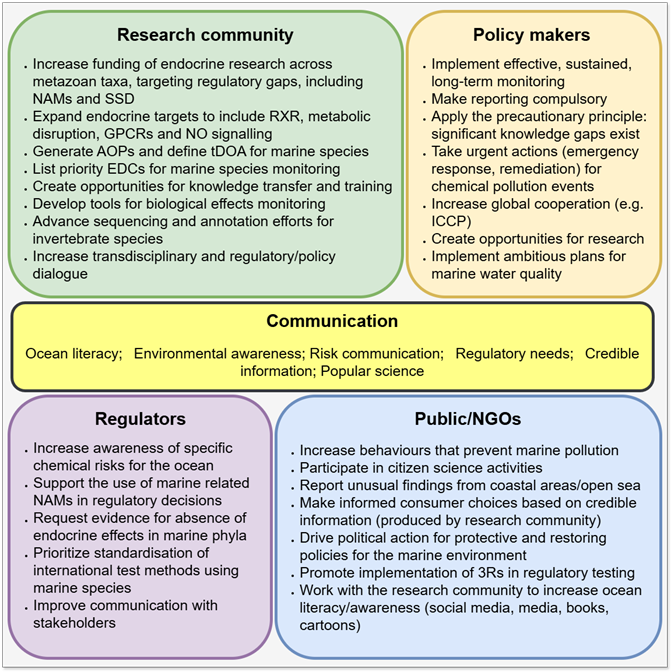
The authors argue that protecting marine biodiversity from chemical pollution will require coordinated global action involving advances and dialogue between scientists, regulators, policymakers, industry and society. Moreover, the network has produced a set of recommendations for the different stakeholders to guide the path forward for increased marine life protection from these micro and invisible threats to oceanic health. They call for the establishment of marine-relevant testing frameworks, improved environmental monitoring and the integration of genomic and bioinformatic tools into chemical-risk assessment.
For CCMAR, this publication underscores the centre’s expanding role in shaping international research agendas and policy discussions on marine health. By leading the Model-EDC initiative and driving high-impact scientific collaboration, CCMAR reinforces its commitment to producing knowledge that informs environmental protection and sustainable ocean governance.
The message from experts is unequivocal: marine pollution respects no borders, and only globally aligned efforts can safeguard ocean life and ensure a healthy, resilient marine environment for future generations.