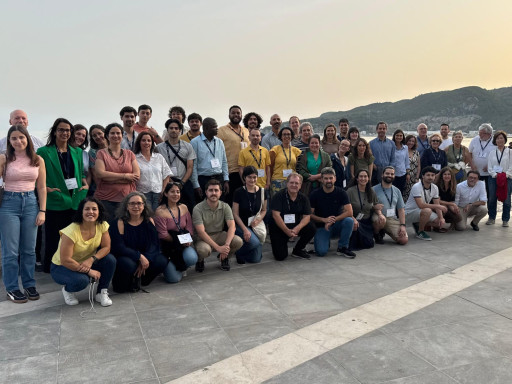
For a few weeks, the Algarve became the epicentre of a scientific and human experience without borders. MOMM – Multiscale Oceanography: From Micro to Macro 2025 brought together 22 participants from 12 countries — including China, Australia, Brazil, Belgium, Spain, Italy, Germany, Portugal, Panama, Malaysia, the United Kingdom and Venezuela — for a unique journey of immersion in multiscale oceanography, organised by the Algarve Marine Science Centre (CCMAR) and the University of the Algarve (UAlg).
Selected from more than 180 international candidates, participants literally immersed themselves in the various dimensions of ocean science — from micro to macro, from the laboratory to the open sea, from molecules to global ecosystems.
The MOMM course is an advanced training programme that integrates online theoretical modules and practical classroom training, combining interdisciplinary knowledge with real-world experiences in the field and laboratory.
During the virtual module, scientists from several countries participated in sessions that explored topics ranging from marine genomics to global ocean circulation, including ecotoxicology, biogeochemistry, plankton ecology, physical oceanography, and environmental data science.
Guest speakers included leading figures such as Josep L. Pelegrí (ICM-CSIC, Spain), Christine Klaas (AWI, Germany), André Belém (UFF, Brazil), Patrícia Pinto and Caio César Ribeiro (CCMAR, Portugal), among many others who shared their knowledge and vision for the future of marine science.

“MOMM was designed to integrate knowledge and tools – experimental, observational and computational – in order to train scientists capable of thinking about the ocean as a complex and interconnected system,” explains the course coordinator, Dr. Caio César Ribeiro.
Laboratories, expeditions and megafauna: science in action
During the in-person phase, held at CCMAR/UAlg, students experienced an intensive week of activities that combined science, collaboration, and culture.
The laboratory sessions covered ecotoxicology, chemical analysis and biotoxins, DNA extraction and quantification, optical microscopy and environmental monitoring, with guidance from experts such as Cármen Sousa, Tainá Fonseca, Carina Mónico e Caio César Ribeiro, Rui Peres do Santos, Antje Volker (IPMA-CCMAR), Joana Cruz, Sandra Lage, and others.
In the field, the group went on expeditions aboard the research vessel MarUAlg, collecting samples of plankton, sediments and water, and observing dolphins and whales in their natural habitat. Activities also included laboratory rotations, inspiring lectures, and even moments of yoga and beach volleyball at sunset, reinforcing the balance between science and multicultural coexistence.
Applied training and international cooperation
In addition to technical training, MOMM valued the development of critical, collaborative and applied skills, encouraging the integration of multiscale data - from in situ sensors to satellite imagery and numerical modelling - for a holistic understanding of marine ecosystems.
The course was also supported by partner institutions and companies, such as VWR International and the Faro City Council, responsible for providing laboratory materials, and BLIFE, which provided discounted accommodation for participants. POGO and SCOR offered financial support grants to students from developing countries, reinforcing MOMM's commitment to global equity and scientific capacity building.
The success of MOMM 2025 was only possible thanks to this extensive network of partners, which also includes SEA-EU – European University of the Seas, IPMA, AWI (Germany), and Brazilian institutions such as UFF, UFRJ, and UFPA.
The event ended with a farewell cocktail party, celebrating science, collaboration, and the new friendships that were formed.
A contribution to the Ocean Decade
In line with the objectives of the United Nations Decade of Ocean Science for Sustainable Development (2021–2030), MOMM promoted an integrated, ethical, and collaborative vision of marine research.

“The ocean is an interconnected system, and training scientists capable of navigating between biological, chemical and physical scales is essential to addressing global sustainability challenges,” summarises Caio Ribeiro.
About MOMM
📍 Organisation: CCMAR – Algarve Marine Science Centre & University of Algarve
🌍 Partners: SEA-EU, POGO, AWI, ICM-CSIC, IPMA, CIMA, UFPA, UFF, UFRJ, UNIFESP, among others
📅 Structure: Online module (concepts and theoretical foundations) + In-person module (field and laboratory)
🚢 Highlight: Scientific expeditions aboard the MarUAlg
💡 Target audience: Undergraduate, master's and doctoral students, and young researchers in marine and environmental sciences
🎓 Coordination: Dr. Caio César Ribeiro (CCMAR/UAlg)