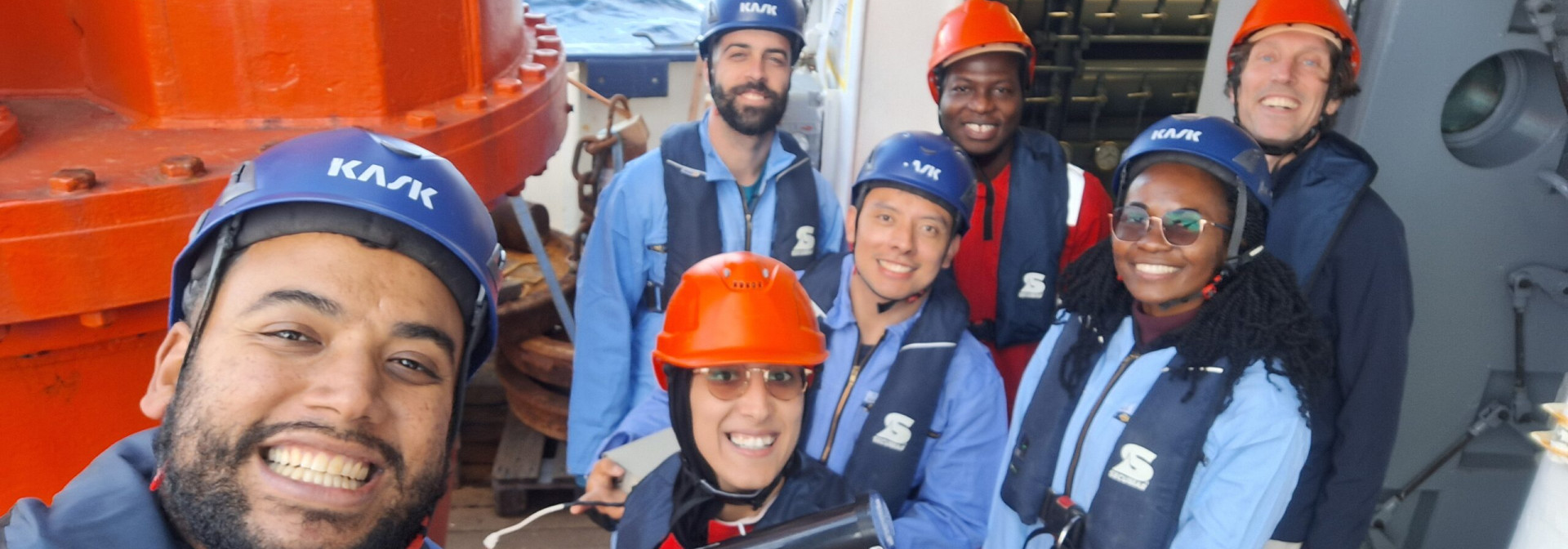
For Caio Ribeiro, a researcher at CCMAR, the Atlantic Ocean became a classroom. He was selected as a junior teacher for the North–South Atlantic Transect (NoSoAT) expedition, organised by the Alfred Wegener Institute (AWI), one of the world's largest polar and marine research centres.
Caio joined a group of only five external teachers, chosen from almost 800 candidates, on board the icebreaker RV Polarstern, en route from Bremerhaven to Walvis Bay. His mission was to train the approximately 20 participating students.

“This selection recognises the path I have been building, which focuses on bridging the gap between research, fieldwork and training young scientists,” says the researcher. ‘For CCMAR, it enhances the institution’s international profile and attracts top students to collaborate with us.’
On board the Polarstern: 24 hours of science on the high seas in the Atlantic
For almost a month, the pace did not slow down, with continuous shifts, scientific operations day and night, and five to six teaching sessions daily. There was also intense interaction between researchers of various nationalities.
Thanks to his experience, Caio Ribeiro played a central role in the expedition's scientific training, taking on teaching and supervisory responsibilities in the Oceanography and Modelling modules.
In the Oceanography module, participants learned how to collect ocean data using a CTD Rosette to measure variables such as temperature and salinity at different depths. They also worked with Ocean Data View (ODV) software to create graphs that help to identify water masses and interpret real data. In the Modelling module, Caio and the students launched over 30 XBT probes, which transmit real-time temperature data back to the ship from depths of up to 1,830 metres. This data was then combined with climate models, observations and reanalyses to study Atlantic processes related to global warming.
Throughout the expedition, a complete transect of the Atlantic was carried out to collect data on carbon, pH, nutrients, phytoplankton and the physical properties of the water. This information forms part of an international time series, which is fundamental to understanding how the ocean responds to climate change.
The bridge between the Ship and Faro
A few days before setting sail, Caio visited a Year 12 class at Tomás Cabreira Secondary School in Faro. There, he talked about his career, the importance of conducting scientific research at sea and the expedition's goals. On 25 November, the conversation continued hundreds of kilometres from the coast when the researcher spoke to the students live from the Polarstern. He answered questions about daily life on the ship, scientific work, and the challenges of life on a research expedition.
A collaboration with a view to the future
For Caio Ribeiro, this mission represents a ‘strategic step’ towards strengthening the collaboration between CCMAR and AWI. "In addition to fieldwork and the exchange of methodologies, we have established a solid foundation for joint publications, new international projects, and opportunities for CCMAR students to participate in future expeditions."
The expedition concluded with a joint lecture delivered by the Junior Teachers, after which Caio received loud applause and a sense of community. 'We returned tired, but with smiles on our faces, and with a very strong bond between us all.' The human element was as remarkable as the scientific one. The interaction on board, the mentoring, and the intercultural exchange between researchers from different countries all contribute directly to training a new generation of scientists who are better prepared to face complex global challenges,' he emphasises.
NoSoAT forms part of the Ocean Capacity Exchange (OceanCapX) programme, which is promoted by the AWI in partnership with the Partnership for Observation of the Global Ocean (POGO), the University of Galway, Trinity College Dublin and the Nippon Foundation, as well as other institutions. The programme provides advanced training in ocean observation techniques, data analysis and ocean governance — skills that are essential for addressing the climate challenges of the next decade.
The participation of a CCMAR researcher further strengthens the centre's position within the international marine science community and its commitment to nurturing the next generation of ocean researchers.