
Type of CCMAR events
There are 10 types of CCMAR events, depending on their primary goal, format, and target audience.
- Seminar
- Toolbox
- Advanced Training
- Scientific Gathering
- Project Meeting
- Outreach Activity
- Get Together
- Press Event
- Institutional Visit
- PhD, MSc and BSc Activity
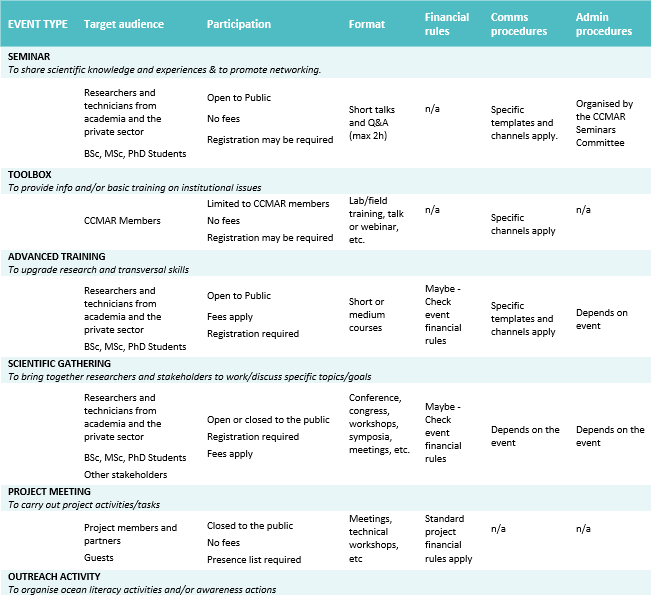
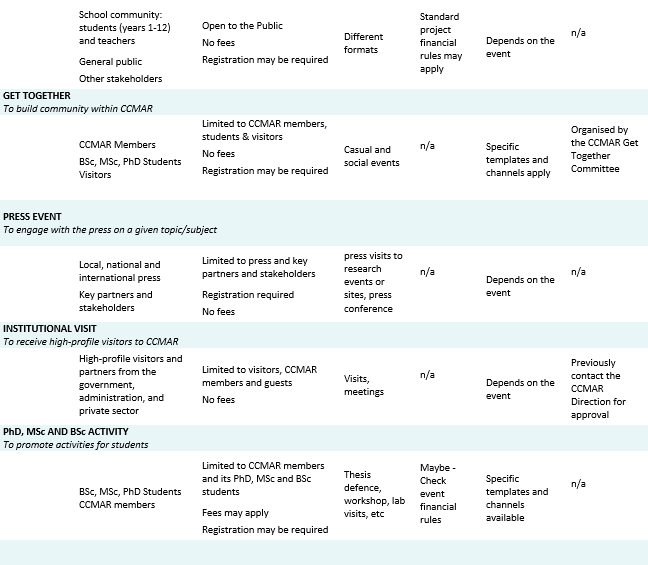
Each type of event requires different financial, administrative and communication procedures. To navigate through the procedures, consult the summary table and workflow below. A detailed description of each type of event follows suit.
Summary table of CCMAR events
Seminars
Main goal
To share scientific knowledge and experiences and to promote networking between visitors to CCMAR and its community.
Target audience
Researchers and technicians from academia and the private sector working in ocean sciences and marine-related sectors, in particular. This entails the entire CCMAR and UAlg community, including their students (BSc, MSc, PhD).
Format
- Short talks followed by Q&A and networking period (max 2h).
- Special editions – short talks given by world-renowned scientists.
- Frequency – every week, except on holiday seasons (Christmas period and August)
Participation
- Open to public.
- No fees.
- Registration may be required (for online seminars).
- Note: if you plan on taking a large group of people (e.g.: MSc class) to a specific seminar, please contact the CCMAR Seminars Committee (ccmarseminars@ualg.pt) to ensure a venue accommodating the additional participants.
Organisation and logistics
The CCMAR seminars are organised by the CCMAR Seminars Committee, with the support of the PhD Students Committee for logistics and the Communication Department for registration and dissemination. Frequency is limited to one weekly seminar, and an annual seminar plan is devised at the beginning of every school year (September). Therefore, members should propose seminars to the CCMAR Seminars Committee (ccmarseminars@ualg.pt) as early as possible. Due to logistical constraints, seminars proposed with less than 15 days’ notice will not be accepted.
Dissemination
The speaker must provide information on the seminar at least 15 days before the seminar date to ensure proper dissemination by completing the web form provided by the seminar organisers. Information includes:
- title;
- speaker’s name, affiliation and photo;
- date, time, venue;
- short description of the seminar (max 250 characters, including spaces);
- a general image + image credits.
With that information, the Communication Department will prepare graphic materials (specific templates apply) for dissemination through the CCMAR website, social media channels and specific mailing lists.
Certificates
The CCMAR Seminars Committee (ccmarseminars@ualg.pt) will issue certificates as requested.
Toolbox
Main goal
To provide info and/or basic training on institutional issues such as internal procedures (admin, finance, comms, human resources, tech transfer, etc), funding opportunities, training on CCMAR equipment, etc.
Target audience
CCMAR members only.
Format
Different formats, such as lab and field training, talks or webinars, and short workshops.
Participation
Open to CCMAR members only. Registration may be required.
Organisation and logistics
Toolboxes are organised by CCMAR members.
Dissemination
Toolboxes are only disseminated within the CCMAR community, as they do not allow external participants. To disseminate the toolbox, the organisers must directly address the CCMAR community via our mailing list invest_ccmar@ualg.pt.
Certificates
Toolbox organizers must provide a certificate to the speaker, using the CCMAR Toolbox Certificate Template available on the intranet. Participants should be asked if they require certificates upon registration. Toolbox organizers may use the same template for that end.
Advanced Training
Main goal
To upgrade research and transversal skills.
Target audience
Researchers and technicians from academia and the private sector. BSc, MSc and PhD Students.
Format
Different training formats and event programs apply as long as they enable capacitation in a specific research field (including methods and technologies) and/or in transversal “soft” skills required to carry out research (e.g., project management, communication).
Participation
Open to the public. Fees apply. Registration is required.
Organization and logistics
Advanced Training can be organised in two ways:
- As part of a project, grant or contract research, in which case they are organized by the CCMAR member responsible for that project or grant. Standard project or contract research financial rules apply. To access communication services beyond those included in the Basic Comms Kit (see section 4), contact the Communication Department (ideally while writing the project/contract research proposal to ensure appropriate budgeting).
- As a CCMAR offer integrated into the Advanced Training Program (former “ATT”), the Communication Department will be actively engaged in the organisation, logistics and targeted dissemination of the course. Specific ATT financial rules apply (see section 3). In this case, the CCMAR member who wants to propose the ATT must contact the Communication Department to jointly prepare and submit the Event Form for approval by the CCMAR Direction.
Dissemination
The Advanced Training is widely disseminated to reach the potential targets. Dissemination channels include the CCMAR mailing lists, website and social media channels. For Advanced Training included in the Advanced Training Program, targeted dissemination activities are also included. To disseminate Advanced Training, the organisers must contact the Communication Department to prepare:
- Registration webforms – at least 15 days before the webform is to be open. Note: webforms must not collect personal information other than the participant’s name and contact e-mail. Payments will be made through a dedicated online payment platform run by the Financial Department.
- Webpage and dissemination graphic materials (specific templates apply) –at least 15 days before the webpage and dissemination materials are to be published (consider at least 2-4 weeks before the event takes place). The following information must be conveyed to prepare the graphic materials: title and short description (max 250 characters); dates, time, venues and other relevant information; speakers (image and affiliation); program; general image + image credits.
Certificates
The Advanced Training organizers must provide certificates for both the speakers and the participants. For that purpose, they may customize the CCMAR Advanced Training Certificate Template available on the intranet.
Scientific Gathering
Main goal
To bring together scientists and other stakeholders to work and/or discuss specific research-related topics and achieve specific goals.
Target audience
Researchers and technicians from academia and the private sector. BSc, MSc and PhD Students. Other stakeholders.
Format
Different formats: From short (a few hours) to long (several days) events. From few and selected participants (e.g.: by invite) to large attendance (hundreds of participants). Includes conferences, congresses, workshops (those that are not focused on capacitation of participants), scientific meetings, symposia, etc.
Participation
Open or closed to the public. Fees may apply. Registration is required.
Organisation and logistics
Scientific Gatherings can be organised in three ways:
- As part of a project, grant or contract research, in which case it is organized by the CCMAR member responsible for that project or grant. Standard project or contract research financial rules apply as long as no fees are charged to participants. To access communication services beyond those included in the Basic Comms Kit (see section 4), contact the Communication Department (ideally while writing the project/contract research proposal).
- As an initiative led by a CCMAR member, the scientific gathering is organized by the CCMAR member leading the event, but an event form must be submitted to the CCMAR Direction. If the event requires support from the Communication Department beyond what is included in the Basic Comms Kit (see section 4), the CCMAR member who wants to propose the Scientific Gathering must contact the Communication Department before submitting the Event Form for approval.
- As a corporate initiative, led by the CCMAR Direction with the support of the Communication Department and CCMAR members.
Dissemination
The Communication Department provides a Basic Comms Kit (see section 4) that includes the dissemination of Scientific Gatherings through the CCMAR mailing lists, website and social media channels, using pre-defined graphic design templates.
However, a “one-size-fits-all” may not be the ideal solution when it comes to Scientific Gatherings, as these events vary widely in format and scope. CCMAR members who are organizing Scientific Gatherings in the scope of a project or contract research are encouraged to contact the Communication Department to discuss and plan the event dissemination (ideally while preparing the project proposal).
If the event does not fall within the scope of a project or contract research, the event organisers must contact the Communication Department before submitting the event proposal to assess potential communication needs.
Project Meeting
Main goal
Carry out internal events within the scope of project activities/tasks.
Target audience
Project members and partners. Guests.
Format
Meetings, technical workshops, kick-off events, etc.
Participation
Closed to the public. No fees. A presence list is usually required (organisers must check if there are communication/financial requirements from the funding agency/entity).
Organisation, logistics and dissemination
Project Meetings are organised and disseminated by the CCMAR members responsible for that project/WP/task. Standard project or contract research financial rules apply, including preparing a presence list of the meeting for financial purposes. If communication services are required, the event organisers must contact the Communication Department, preferably at the time of project submission or as early as possible to ensure a proper financial envelope.
Outreach Activity
Main goal
To organise ocean literacy activities, teaching and/or awareness actions.
Target audience
School community: students (years 1-12) and teachers. General public. Other stakeholders
Format
Different formats: presence in fairs and other community events, school engagement activities, guided visits, etc.
Participation
Open to the public. No fees.
Organisation and logistics
Outreach activities can be organised by the Communication Department, by CCMAR members or – ideally - by both (in collaboration). Regarding financial requirements: when these activities are integrated into projects, standard project or contract research financial rules apply. The Communication Department should be involved in project submission or as early as possible to ensure a proper financial envelope.
Dissemination
The Communication Department provides a Basic Comms Kit (see section 4) that includes activities that may be used to organise and disseminate these activities. More advanced communication support may be provided, depending on available resources. CCMAR members are encouraged to contact the Communication Department in advance when planning outreach activities.
Get-Together
Main goal
To build a CCMAR community.
Target audience
CCMAR community: members, BSc, MSc and PhD students, and visitors.
Format
Casual and social events.
Participation
Limited to CCMAR members, students & visitors. No fees. Registration may be required.
Organisation and logistics
Get-togethers are organised by the CCMAR Get-together Committee. To propose a Get-together or to join this committee, please contact gettogetherccmar@ualg.pt
The CCMAR Direction should be informed of the organisation of Get-togethers.
Dissemination
Get-togethers are only disseminated within the CCMAR community, as they do not envisage external participants. The Communication Department supports the Get-together Committee by preparing the graphic materials (specific templates apply) for dissemination through the mailing list invest_ccmar@ualg.pt and basic registration forms. For this, the following information must be sent to the Communication Department in advance:
- Title
- Date, time, venue
- Other relevant information (e.g.: theme, specific needs)
The event coverage may be carried out by the Communication Department and posted on social media.
Press event
Main goal
To engage with the press on a given topic/subject
Target audience
Local, national and international press. Key partners and stakeholders.
Format
Press visits to research events or sites, press conferences.
Participation
Limited to the press and key partners and stakeholders. Registration may be required.
No fees.
Organisation and logistics
Press events are organised by the Communication Department. CCMAR members willing to engage with the press must contact the Communication Department to jointly develop a press engagement strategy, which should then be approved by the CCMAR Direction. The Communication Department provides a Comms Press Kit to ensure press engagement (see section 4.3).
Institutional Visit
Main goal
To receive high-profile visitors to CCMAR
Target audience
High-profile visitors and partners from government, administration, and private sector.
Format
Visits, meetings.
Participation
Limited to visitors, CCMAR members and guests. No fees.
Organisation and logistics
Any CCMAR member can organise an institutional visit. The CCMAR Direction needs to be informed of these visits. The Communication Department must be involved.
PhD, MSc and BSc Activity
Main goal
To promote the student community's event activities at CCMAR.
Target audience
BSc, MSc, PhD Students. CCMAR members.
Format
Thesis defence, workshop, lab visits, etc.
Participation
Limited to CCMAR members and its PhD, MSc and BSc students. Fees may apply. Registration may be required.
Organisation and logistics
Any CCMAR member can organise an event targeting the student community of the centre.
Dissemination
Event activities targeting the centre’s student community are widely disseminated within the CCMAR community and, if applicable, to the outside through our social media channels. For dissemination, the organisers must contact the Communication Department with at least 15 days’ notice to prepare graphic materials (specific templates may apply).